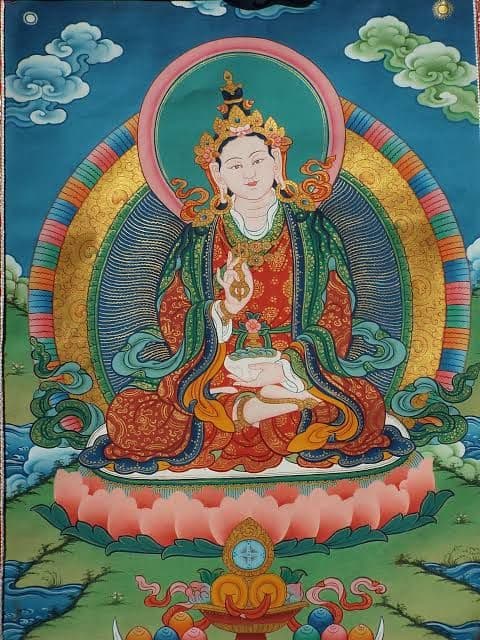
Ngagpa: Another Way of Devoting One's Life to the Dharma
- 11 Aug 2026
- 11 min read
What a ngagpa is – and is not
Picture a person who wears robes. This person, it turns out, dedicates their life to Buddhist practice. Are you thinking of a monk? If so, you may be right, but you may not be. In the West we tend to associate committed Buddhist practice with taking monastic vows. In reality, however, within the Dharma traditions the figure of the ‘ngagpa’ has existed for centuries: a lay, non-monastic, non-celibate tantric practitioner who may have an “ordinary” job, marry or have children. Basically, someone who takes part directly in society and, at the same time, upholds a very demanding discipline of the Dharma, devoting much of their life to it (if not all of it, at heart).
In Tibetan, ‘ngagpa’ (‘ngagmo’ in the feminine) means ‘practitioner of mantras’. But the term does not simply refer to someone who recites texts and prayers, who meditates and carries out rituals. Although they also do these things, ngagpas are people initiated into the methods of Vajrayana, linked to a teacher, sustained by specific commitments, and dedicated to ritual transmission and realisation: to unveiling the mind in order to free all beings from suffering. This matters because these practitioners have sometimes been confused with “magicians” or “shamans”, when in fact the role of the ngagpa goes far beyond ritual practice, is inseparable from bodhichitta, and their existence has been essential to the transmission and preservation of the Dharma over time.
What forms can a ngagpa take? From inherited lineages to independent teachers (and irreverent ones)
Because ngagpas are non-monastic, the practice of these Buddhist yogis has developed mainly in local communities, far from large institutions. For this reason, the ngagpa tradition is very diverse and reflects a variety of customs and knowledge depending on the environment or lineage of each practitioner. At times, ngagpas belong to family lineages passed down from generation to generation, as is the case with Sachen Kunga Nyingpo, the first great Sakya patriarch, born into the Khön family in the eleventh century, who from a very young age received profound teachings that culminated in the transmission of the Lamdré, one of the most distinctive meditation systems of the Sakya school.
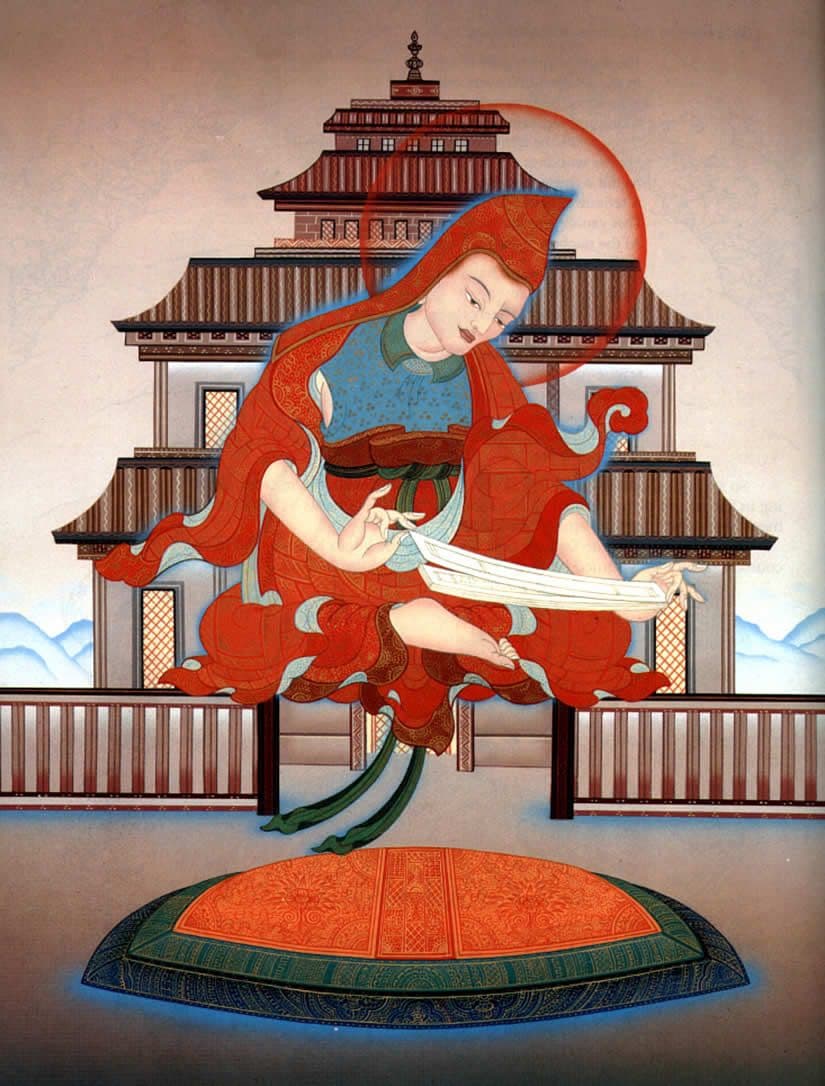
But a ngagpa does not have to belong to a family lineage; they may also be a wandering yogi, a hermit or an independent teacher. Although rooted in the Indian rather than the Tibetan context, Virupa (9th–10th century) was initially a scholarly monk at the University of Nalanda who, after years of apparently fruitless practice, attained a sudden realisation that radically transformed his way of life. From then on, he abandoned external monastic conventions and adopted the free and at times provocative behaviour characteristic of the mahasiddha or “great adept”, the Indian model of unconventional tantric realisation.
A century later we find the figures of Marpa and Milarepa, teacher and disciple who devoted themselves to the Dharma far from the monastery. Marpa lived as a householder, with a wife and children, and combined domestic life with intense tantric practice and rigorous transmission of lineage. His most celebrated disciple, Milarepa, represents another pole of the same spectrum: it is said that after a youth marked by negative actions, he underwent severe trials under his teacher's guidance, purifying his karma through extreme effort. He later withdrew to live in high mountain caves, devoting himself almost exclusively to meditation and attaining profound realisation. Although Milarepa was not a householder ngagpa, his life exemplifies the ideal of the ascetic yogi who, through discipline, devotion and direct practice, attains liberation in a single lifetime.
In these very different examples of non-monastic practitioners we can see that, ultimately, what defines a ngagpa is their bond with Vajrayana and, as we said, they are not simply a devoted lay practitioner, but someone who has received initiations, textual transmissions and essential instructions, and who takes on specific commitments such as, among others, the vows of refuge, the bodhisattva vows, the tantric samaya and other commitments of sustained practice.
The origin of the ngagpa tradition and the figure of Guru Rinpoche
It was in eighth-century Tibet that Guru Rinpoche (or Padmasambhava) formalised the community of ngagpas for the first time, together with the imperial and monastic authorities of the time. Guru Rinpoche, regarded as the original ngagpa and the founder of Tibetan Buddhism, established this twofold structure within the ‘sangha’, or community of practitioners: on the one hand, the sangha of monastics, characterised by shaven heads and saffron-red robes; on the other, the sangha of non-monastic tantric practitioners, the ngagpas and ngagmos, recognisable by their white attire and long hair.
In this way, the respect owed to the non-monastic sangha was emphasised, as it was equally responsible for upholding the Dharma as the monastic sangha, and both forms of practice were recognised, validated and regarded. This is shown by the following passage from the Pema Kathang, a twelfth-century text on the life of Padmasambhava and his teachings, translated into English by the cultural anthropologist Ben Joffe:
«The sacred Dharma consists in behaving correctly. For this reason, the community of renunciate monks and the community of ngakpas, or non-celibate tantric yogis, who have taken vows, have been established. Let each one choose the religious orientation they prefer between these two».
Alongside the figure of Padmasambhava stands the teacher Yeshe Tsogyal, an example of a non-monastic lay practitioner, a ngagmo. This yogini, Padmasambhava's principal disciple, transmitter of teachings and central figure in the preservation of the spiritual treasures or “termas”, was not only a passive recipient of the teachings but a fully accomplished practitioner who attained enlightenment and played an active role in transmitting these texts to future generations. Her figure embodies the possibility of female spiritual realisation in the Vajrayana, although historically ngagmos have usually been linked to a male ngagpa, with whom they maintained a relationship.
Transmission of the Dharma in Times of Crisis: The Role of Ngagpas Past and Present
Ninth and tenth centuries - the “Tibetan Dark Age”
The role of the ngagpas has evolved over the centuries. Traditionally, the ngagpa community played an important role in transmitting and adapting Buddhist teachings in Tibet, especially during periods of political instability such as the so-called “Tibetan Dark Age” or “Era of Fragmentation”, roughly between the ninth and tenth centuries. In that context, many tantric practices of Indian origin were integrated into Tibetan culture through family lineages and communities of practitioners situated outside the large centralised monastic institutions.
Twentieth century - exile
In the contemporary period, especially among Tibetan communities in exile since the 1950s, the ngagpas have adapted their practices to the needs of the diaspora, taking part in rituals, religious education and cultural preservation. The knowledge associated with these lineages is increasingly being documented through preservation projects, such as the digitisation of manuscripts that show the importance of the ngagpas as transmitters of knowledge.
In the twentieth century, notable ngagpas include Dudjom Rinpoche, a master of the Nyingma school who, although he had received monastic vows, lived most of his life as a lay tantric practitioner and was a key figure in the preservation and dissemination of Tibetan Buddhism after exile. His activity included compiling texts, transmitting complete cycles of teachings and training disciples both in the Himalayas and in the West. Dilgo Khyentse Rinpoche, on the other hand, was married and maintained a family life during certain periods. At other times in his life he undertook prolonged retreats and devoted himself to teaching countless disciples and to the international spread of Dzogchen and other advanced practices at risk of disappearing.
Twenty-first century - globalisation
In the present we have, for example, Jetsun Kushok. Born into the Khön family of the Sakya lineage, trained from childhood and a qualified transmitter of the Lamdré, this distinguished ngagmo shows that non-monastic tantric authority has also had female expressions of great relevance. Thus we see that the role of contemporary ngagpas has evolved to meet global needs, preserving knowledge while bringing it closer to and adapting it for modern societies.
So, at Casa Virupa… are you monks or what?
It is precisely this desire to bring the Dharma closer to everyday life that moves and gives meaning to Casa Virupa, the retreat and meditation centre guided by Lama Norbu and sustained by a community of practitioners who follow the ngagpa model. Thus, without Can Bordoi being a monastery, nor we nuns or monks, we make use of our worldly occupations and interests, shared child-rearing and emotional bonds as ground for practice. We are committed to engaging fully with society, to the point of organising concerts, jam sessions, talks on philosophy and an annual festival of contemplative arts, observing the potential that joy, music, the humanities and rest have to transform the mind.
Besides incorporating the Dharma into every aspect of life, as ngagpas we also carry out practices and rituals proper to the Vajrayana tradition. For example, reciting mantras, holding weekly Pujas, organising Monlams (festivals of aspiration prayers) and striving to adapt these practices to the Western and Mediterranean context in which we live. We do all this under the guidance of our teacher, Lama Norbu, who inspires and accompanies us from his deep knowledge of the traditional teachings, his human sensitivity and collective vision.
The purpose of committing to the ngagpa model
For us, following the ngagpa model makes sense because it lets us open ourselves to the new concerns and challenges of today's society. Since we live ordinary lives, we can draw closer to the everyday reality of people who are interested in delving into the Buddhism we practise, making it more accessible and relevant to them. In this way, with the utmost respect for the Tibetan tradition that has brought the wisdom of the Dharma down to us today, we are feeling our way towards new ways of practising Vajrayana in our own time. In doing so, we aim to steer clear of colonial projections and of unreflective cultural assimilation, bearing in mind that the Dharma has been adapting since its origin so that it can serve in different contexts and, for that reason, it makes sense for us to keep insisting on translating it so that it can take root in our culture. This takes shape, for example, in committing to our native languages, using local materials for traditional objects such as khatas, drawing on references close to our reality, and holding dialogues that challenge us when giving teachings or meditation courses.
Once again, this work of adaptation would be impossible without the wisdom of Lama Norbu, acquired over many years of rigorous practice and exposure to the teachings and transmissions of his masters in the Sakya school. Living close to him, and to the community of practitioners, helps us sustain the ngagpa commitment: the effort involved in integrating the Dharma into a life that is in part ordinary and which, at the same time, offers an extraordinary potential for transformation.
FAQs
- What is a ‘ngagpa’?
- A ngagpa is a non-monastic tantric Buddhist practitioner, initiated into the methods of Vajrayana.
- Who can be a ngagpa?
- Both men and women can be ngagpas (or ngagmos, in the feminine), and there are many historical examples of women practitioners of this model.
- So the members of the Casa Virupa community are not monks or nuns?
- No. Casa Virupa is not a monastery but a community of practitioners who follow the ngagpa model: we lead ordinary lives, we have our “mundane” occupations, we share the raising of children and we engage directly with society.
- What does the day-to-day life of a ngagpa practitioner look like?
- This depends a great deal on the individual, but at Casa Virupa our recent everyday life looks a bit like this (see video on Instagram)
___
Sources consulted:
- Ben Joffe (2015) Tantra and Transparency, or Cultural Contradiction and Today’s Tibetan Buddhist Wizard https://savageminds.org/2015/10/06/tantra-and-transparency-or-cultural-contradiction-and-todays-tibetan-buddhist-wizard/
Pema Khandro (2015) Tibetan Yogis – the Ngakpa Lineage
https://pemakhandro.org/pema-khandro-ngakpa-lineage/
- Rigpawiki.org (2021) Ngakpa
https://www.rigpawiki.org/index.php?title=Ngakpa
Ben Joffe (2018) How to Mind Your Tantric Business: Padmasambhava’s Parting Words of Advice to Tibetan Ngakpa
https://perfumedskull.com/2018/07/13/how-to-mind-your-tantric-business-padmasambhavas-parting-words-of-advice-to-tibetan-ngakpa/
- Alexander Berzin (2016) Renaissance after the Fall of the Tibetan Empire
https://studybuddhism.com/es/estudios-avanzados/historia-y-cultura/budismo-en-el-tibet/historia-tibetana-antes-del-quinto-dalai-lama/renacimiento-despues-de-la-caida-del-imperio-tibetano