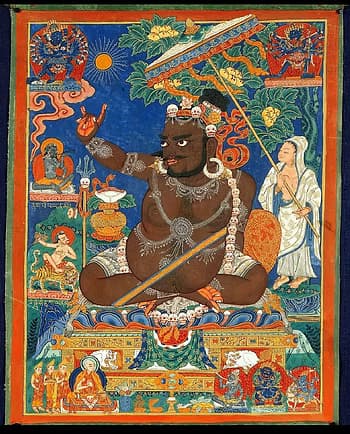
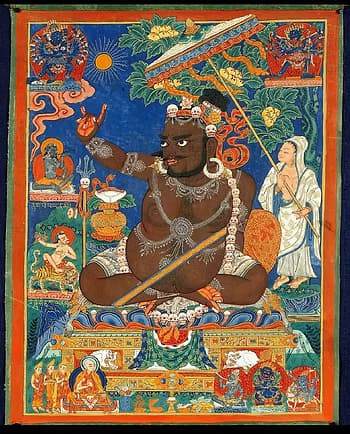
Who was Virupa
- 7 Feb 2026
- 15 min read
The story of the Mahasiddha Virupa
Birth of Virupa
The Mahasiddha Virupa, Lord of all yogis, was born into a royal family in eastern India during the 7th-8th centuries CE. He later renounced the life of a prince to join a monastic sangha. He took ordination from Abbot Vinayadeva and the teacher Jayakirti at the Somapuri temple in India. He built a small stone temple filled with representations of the Triple Gem, which purified the obscurations of his parents.
Nalanda University
The great Nalanda University was the most famous teaching institution of its time and was immersed in the four schools of Buddhist philosophy. He entered the university and received the full vows of ordination from Abbot Dharmamitri of the Mulasarvastivada School. He was given the ordination name "Shri Dharmapala" and received the instructions of Chakrasamvara from the Abbot. He perfected an oceanic knowledge of Buddhist and non-Buddhist schools. His Abbot passed into parinirvana and Virupa was enthroned as Great Abbot of all panditas at Nalanda University.
Mahasiddha Virupa
Virupa maintained the Chakrasamvara practice during the nights, while teaching Sutrayana, debating and composing Dharma texts during the day. He practised for many years without obtaining any signs or accomplishments. Not only that, but he also encountered many unfortunate circumstances and became discouraged with his practice. Thinking that he had no connection with the secret path of Mantrayana in this life, he decided to spend his time solely focused on the study and contemplation of the common vehicle. He made a vow that from now on he would not teach the Dharma, write Dharma texts or do any yidam practice.
On the 22nd day of the fourth month of the lunar spring (Vesak) he threw his mala into a toilet as a symbol of his abandonment of practice and his intention to take everything calmly. That same night, in a dream, he saw Nairatmaya as an ordinary blue lady who said: "Noble son, please do not behave in this improper way. Please take back your mala, wash it in scented water, confess your mistake and promise not to repeat this again, and from now on maintain the practice correctly." She continued: "I am the deity with whom you have a karmic connection. I am now bestowing blessings so that you may achieve your accomplishments quickly." She then disappeared.
Accomplishments
When he woke the next morning, Virupa was filled with great remorse. On the 23rd day of the lunar month, he picked up his mala and followed the instructions given in his dream. That night he perceived primordial wisdom in the form of the mandala of fifteen goddesses of the manifestation of Nairatmaya-Nirmanakaya. The four empowerments were fully bestowed and he attained the result of the accomplishment of the first bhumi (stage of enlightenment) that same night. Over six consecutive nights, Virupa achieved growing realisations and on the seventh night, the 29th day of the lunar month, he attained the sixth bhumi, obtaining blessings from the four aspects of the whispered lineage.
Strange behaviour
After this, Virupa's behaviour changed. Rumours spread in the monastery that he was eating meat and drinking alcohol. Some monks who spied on him saw fifteen, and another monk saw a hundred women in his room, while other monks only saw fifteen or a hundred candles. Therefore, there was great controversy. Although he was still the Great Abbot of Nalanda University, no one had the courage to speak plainly.
In order to prevent others from disparaging the Buddhadharma, he admitted his mistakes, left his residence, and offered his robes and his bowl to the Triple Gem. He went completely naked saying that he was ugly and took the name "Virupa", which means "the ugly one". He began to behave strangely. He would go to flower sellers to ask for flowers to make garlands for his head, and went to buy radishes from a radish seller and held some of them in his hands and put them in his mouth. He began to frequent pubs and brothels, to everyone's great surprise.
The Dharma drum sounded in the monastery to gather all the monks. It was declared that Virupa should leave the monastery and never return. Virupa composed a poetic song to benefit the Buddhadharma and remove the prejudices of beings. He admitted his mistakes and walked towards Benares (Varanasi), crossing the River Ganges on the way.
Recognition
On reaching the banks of the River Ganges, he said to the river: "I am bad, I do not want to contaminate you, please give me a path". The river parted and he crossed it without difficulty. Others, who had followed him, saw this and realised his enlightened qualities. Many people lamented his rejection and held onto his feet asking him to return to the monastery. He accepted their remorse, but could not agree to return to the monastery.
On arriving in Benares, Virupa spent a long time in the forest. He became very tanned and worn by the weather. Some people thought he was a non-Buddhist yogi, while others thought he was a Buddhist. The Hindu king who ruled Benares at that time, Govindacanda, thought that if Virupa was Hindu he wanted to invite him to the palace, but if he was Buddhist, the king wanted to expel him from the kingdom. So the king ordered that Virupa be brought to the palace, so that he could decide Virupa's fate.
On the way to the palace, Virupa was seen putting the insects and butterflies he came across into his mouth. This caused people (and also the insects in his mouth) to call him "cruel, cruel yogi". Virupa said: "Even people who kill many animals say "cruel, cruel", and others who rescue beings are also called "cruel, cruel", which shows that you do not understand my actions". In truth, Virupa was an enlightened bodhisattva and did not harm any being, not even in the slightest way, but freed these beings. He was also showing these people how to recognise their own cruelty when they made animal sacrifices.
When he met the king, who asked many questions, Virupa remained silent. The king said that Virupa had no signs of being a Hindu yogi and therefore ordered that he be bound and thrown into the river. As soon as Virupa was thrown into the river, he immediately reappeared in the king's palace. They tried to destroy him many times in many different ways and each time he reappeared. As a result, the king realised that Virupa was enlightened and confessed his sins. Unshakeable devotion arose within him and in this way the whole kingdom was brought onto the path of Vajrayana.
Many miracles, many disciples
On the way south to Bhimesvara, Virupa came to the banks of the River Ganges to meet a person with whom he had a karmic connection. Virupa asked to be taken across the river and the boatman asked to be paid the fare. Virupa said he would fully satisfy the boatman's request and asked the boatman whether he wanted the river to be bigger or smaller. The boatman said he would prefer the river to be smaller. Virupa pointed his index finger at the river, which then reversed. The houses on the grassy banks of the river began to shrink and the waters grew, which frightened many people.
The boatman pointed to Virupa as the cause of this. The local people brought many offerings of livestock, crops, gold and jewels and begged Virupa to stop. Virupa snapped his fingers and immediately the river began to flow normally again. All the offerings, Virupa gave to the boatman. The boatman refused to accept the offerings and, feeling great devotion, fell at Virupa's feet, begging to be accepted as his student. Virupa then returned all the offerings to the local population and everything went back to normal. The boatman became known as Dombi Heruka, one of Virupa's two principal disciples.
Virupa then continued his journey to nearby Bhimesvara, in southern India, to a place called Dakinitapa, where he entered a local wine shop owned by a woman, Karmarupasiddhi. He and his disciple Dombi asked for wine, but the owner asked to be paid. Virupa said that once they were satisfied, she would get whatever she wanted. She did not believe him and asked again when they would pay her. Virupa drew a line on the ground and said that when the shadow reached the line, he would pay immediately. Virupa had stopped the sun. He began drinking calmly and kept drinking until all the wine in the shop was finished.
The woman again wanted to know when she would receive payment, but Virupa repeated that the shadow had not yet reached the line. Virupa kept drinking until, with all the wine of eighteen nearby towns, he was drunk! When this happened, the king's astrologers were confused; the timing of daily routines was disrupted; people could not cope with the lack of sleep. There was widespread chaos. The king realised this had been caused by Virupa's miraculous power and urgently asked him to release the sun.
Virupa explained that he did not have the money to pay the owner. The king agreed to pay the woman and then Virupa released the sun, which immediately set. It was midnight on the third day since these events began. In this way, Virupa brought many people onto the path of Vajrayana. Virupa stopped the Ganges twice and also stopped the sun, causing his fame to spread everywhere. He then continued on to Bhimesvara.
Prostrations to prajnaparamita
On arriving at Bhimesvara, Virupa went to visit a non-Buddhist temple where there were five hundred long-haired saddhus . Virupa praised the king, Narapati, in Sanskrit and the king was greatly impressed by his learning and appointed Virupa head of the five hundred yogis. Virupa maintained his personal practice, making offerings and prostrations to the prajnaparamita texts instead of to the worldly gods that the yogis venerated. This caused some controversy, since Virupa was not practising in accordance with his tradition, and this was conveyed to the king. At first, the king did not believe the yogis. He thought the yogis were jealous and that it was impossible for such a great Sanskrit scholar not to respect his gods, so the king ignored them.
After many repeated complaints from the yogis, the king began to have doubts about Virupa. The king summoned all the yogis to the temple and asked each of them to prostrate before the image of the gods. All the yogis prostrated as expected, except for Virupa, who remained prostrate upon the prajnaparamita texts. The king said that this was the highest of the gods of the desire realm and therefore Virupa must show respect. The king demanded that Virupa prostrate before his god, but Virupa said that he could not. Virupa then spoke to the statue of the god, saying: "This sinful king has forced me to prostrate before you, please show tolerance towards me." Virupa then joined the palms of his hands at his forehead, reciting "Namo Buddhaya!" and immediately a third of the statue broke. He then placed his palms at his throat, reciting "Namo Dharmaya!" and immediately two thirds of the statue broke. Then Virupa placed his palms at his heart and recited: "Namo Sangaya!" and immediately the crack spread along the length of the statue. Virupa continued prostrating in the four directions and, as he did so, the statue broke into four pieces.
The king and the entire retinue were greatly frightened. They fell at Virupa's feet and asked him not to continue. Virupa then gathered the four pieces and the statue re-formed as it had been before. Virupa then placed an image of Avalokiteshvara made of black stone on the head of the statue of the god and asked everyone to prostrate and circumambulate it. Virupa advised them that if they did not treat this statue with due respect, it would not last. As a consequence of this miracle, many people began to place images of the Buddha on the top of the heads of their own statues of worldly gods. In this way, Virupa demonstrated that prostrating before worldly gods can be more harmful than beneficial. Virupa was an enlightened bodhisattva on the sixth bhumi, whose level far exceeds the power of worldly gods.
On the Path of the Dharma
Virupa then continued further south. Among the 500 sadhus at Bhimesvara was Kanha, who followed him and later became Virupa's second principal disciple, Krishnapa. In fact, Virupa had gone there to meet Krishnapa and bring these sadhus to the Buddhadharma. In southern India there was a place with a statue made of red wood where, every day, hundreds of buffaloes were killed and used as offerings to worldly gods. Virupa kicked the statue and asked the deity to leave. Immediately, the statue rose up and Virupa moved it aside. All the followers of the deity were frightened and begged Virupa to stop. Virupa said that if they stopped killing animals as sacrifices, he would stop, but if they continued killing innocent beings, he would take this deity away. In this way, Virupa and his two followers, Dombi and Krishnapa, continued their journey together.
They subdued many other worldly gods and put an end to the killing of animals in many places. Virupa gave Dombi, the boatman, the blessing of the complete transmission of all of Virupa's understanding, so that Dombi attained an understanding equal to Virupa's. Virupa sent Dombi to eastern India, where he subdued many beings and led them onto the path of the Dharma. Krishnapa went with Virupa to Karsapani to meet Avalokiteshvara, where they performed many prostrations and showed great respect. Virupa explained to Avalokiteshvara everything he had done from the time he became a monk up to that day, and offered it to Avalokiteshvara for the benefit of the Buddhadharma. Avalokiteshvara explained to Virupa: "You have great power and could reduce Mount Sumeru to ashes! All sentient beings have various karmas that even the Buddha finds difficult to subdue, so do not harm conscious beings and show them great compassion."
Virupa travelled to Saurashtra in western India, where thousands of animals were sacrificed every day to the deity Somanatha. Following Avalokiteshvara's advice, Virupa stopped these sacrifices without destroying the statue. The devotees committed to making offerings of rice and other harmless offerings instead of animals.
The Spread of Vajrayana
Virupa built a temple with an image of the Buddha and beneath this statue he placed an image of himself. He developed a monastic community and asked benefactors to make offerings first to the Buddha, second to the statue, and third to their own worldly gods. He said that if they did so, Virupa would not destroy their god, but would leave it unharmed. The community requested that Virupa accept their offerings and remain for as long as Somanatha existed. Virupa blessed Krishnapa with the verses of Vajra, bringing him to the same level of realisation as Virupa himself. Virupa asked Krishnapa to go to the eastern world to bring all beings onto the Vajrayana path.
After concluding his activities in Saurashtra, Virupa temporarily ceased his activities and dissolved into the stone statue, Somanatha. It is believed that Virupa is in that place today and there are many accounts of miracles occurring there. Near this temple there is a statue of Mahasiddha Virupa. Some say it is a statue and others say it is the real Mahasiddha Virupa. He is seated in meditation posture with a philosopher's stone in his left hand that turns common metals into gold. Its size varies, becoming very large if it is not respected, so that one cannot even see the head. If it is respected and offerings are made, it becomes as small as a baby and all wishes are fulfilled. Through the transformation into gold, many beings have been lifted out of poverty.
Current News: Nalanda University
There are many stories of the countless miracles performed by Virupa to bring innumerable beings onto the path of the Vajrayana. The Buddhadharma flourished greatly in India as a consequence of his existence, and indirectly in Tibet through the activities of his students. Almost all the Buddhist traditions found in Tibet can be traced through lineages that originate at Nalanda University. Among the many masters and scholars produced by this institution, Virupa is the most outstanding.
In the whole history of Buddhism, there has never been another master who has shown such courage in serving the Buddhadharma. Indeed, it is said that there are three great masters, more important than others, who followed Gautama Buddha: King Ashoka ruled the country and, through his power, brought peace to the land and a flourishing of the Dharma; Dharmakirti, through his logic, defeated many heretical views; and Virupa, through his yogic discipline, subdued many distorted paths and brought many beings to the Vajrayana.