Living as a Beast, a Demon, a Spirit and a Human in One Day | The 6 Realms of Existence
- 19 Oct 2025
- 9 min read
The 6 Realms of Existence
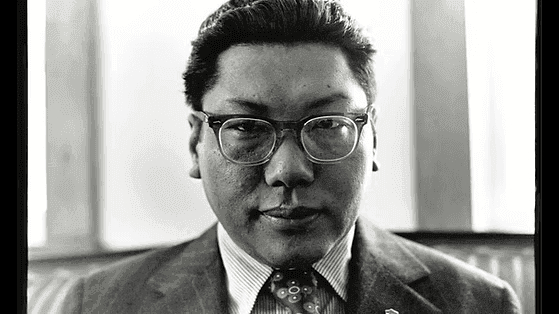
Chogyam Trungpa Rinpoche was a very clear example of fearlessness: we owe to him a view of the Dharma that is raw, fresh and alive, which, were it not for the wisdom and skilful means of a great teacher like him, would hardly have reached our hands and shaped the way we understand the Dharma. Moreover, I suppose we must have done something good in other lives, because although we cannot have Trungpa Rinpoche in person, Lama Norbu is an excellent medium of the Trungpian vision and practice.
The vision of the six realms of existence in Buddhism according to Chögyam Trungpa
The topic I have chosen is that of the six realms of existence, because I think Trungpa Rinpoche's perspective is fascinating in how illuminating it is, and because our materialist bias rests more comfortably on this explanation of the six realms than on the more traditional ones. Even so, at the end I will try to justify why the orthodox view of the six realms is absolutely useful and necessary.
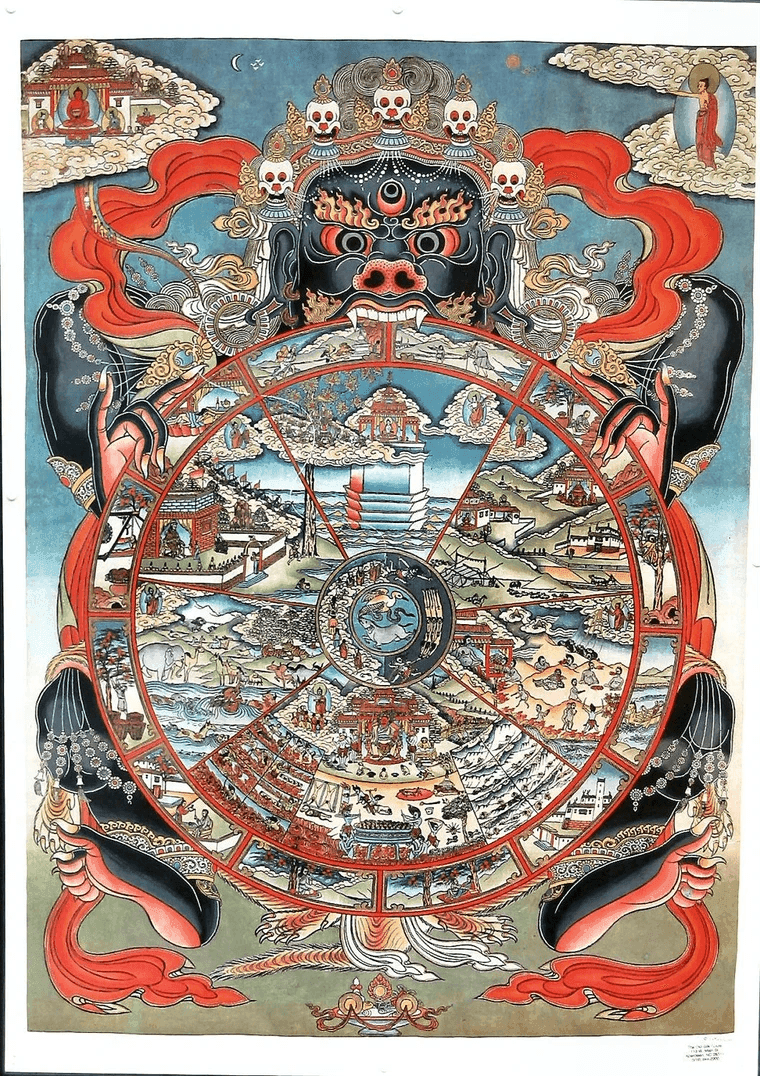
Trungpa Rinpoche begins by pointing out that the six worlds arise because "we settle into a particular version of reality". Thus, our need to fix what we know and what feels familiar ends with us imprisoned between the walls of our neuroses and insecurities, instead of opening to awake space. Our intolerance of the certainty of uncertainty shackles us to suffering and confusion. It is from this perspective that Trungpa Rinpoche will speak of the six realms of existence: that of the gods, that of the jealous gods, that of humans, that of animals, that of hungry ghosts and that of the hells. For the teacher, these are not exclusive planes of one type of being; rather, an individual can pass through all the realms of existence in a single day, since they represent mental attitudes.
The realm of the gods is the one whose basic principle is mental fixation, literally: "a meditative abstraction based on ego, on spiritual materialism". In my view, Trungpa refers to this state in two ways: as an obstacle on the spiritual path, characteristic of more advanced practitioners, and as the mental state of those who, even without having entered the spiritual path, are distracted by luxuries, pleasures, abundance, etc., and do not spend their lifetime practising.
As for the first type of individuals, he describes their process through different ways of fixing experience and spiritual development. On the one hand, the practitioner runs the risk of clinging to the fruits of practice. To my mind this bears some parallel to the prerequisite for the practice of samatha of "discarding the bustle of many projects". At the same time, he also explains it as clinging to a technique or practice itself. Lastly, he also seems to point to getting stuck at a stage of deep, but not ultimate, realisation.
As for the second type of individuals, Trungpa Rinpoche speaks of those who are dazzled by a hedonistic life, given over to pleasure, extremely comfortable, who live as if time did not pass for them. Each new step in life is an adventure, an opportunity for entertainment.
Both the individuals I described earlier and those I have just referred to, although they have a fairly calm and relaxed existence, suffer because, as Trungpa Rinpoche says, "pain comes from the final disillusionment". Sooner or later these individuals realise that none of the states they have acquired or enjoyed will last. Then a certain sense of helplessness, of being cheated, floods these beings.
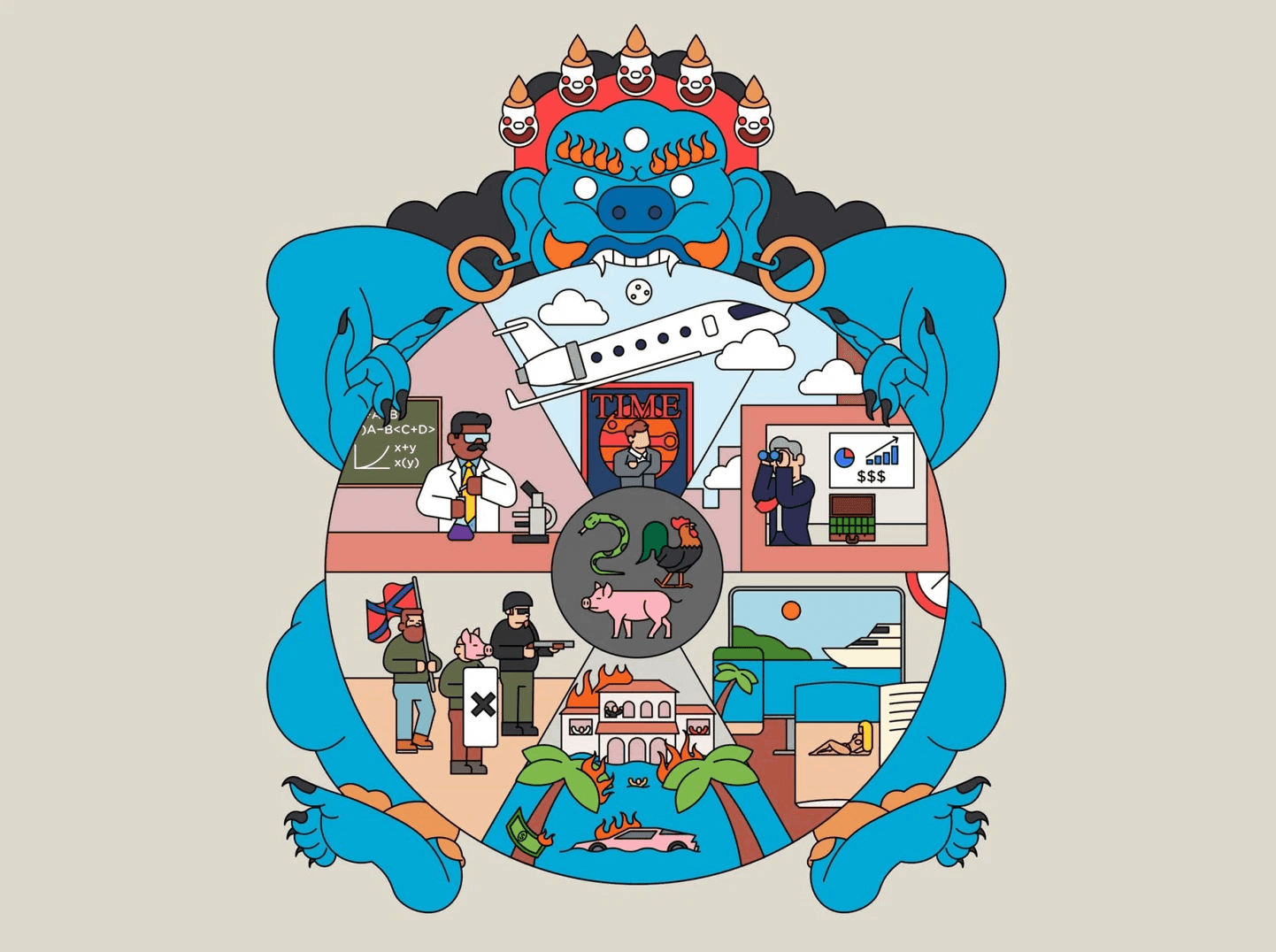
The second realm is that of the jealous gods, or the asuras; according to Trungpa Rinpoche, what abounds on this plane is paranoia. I interpret the teacher's explanation as an attitude of constant distrust towards others, since everyone may potentially become a rival, if they are not already one, according to the asura. It is also the territory of arrogant intellectuals, who boast of the conceptual universes they inhabit and which only they can decipher, without realising that they are as fragile as a house of cards. In truth, they would like the comfort and indifference of the gods, but a perpetual unease, a not accepting oneself as one is, suspicion of oneself and of others, keeps them sleepless.
As for the realm of animals, the teacher defines the tone of this realm as stupidity and, more specifically, the blindness that arises when one "stubbornly pursues particular goals", without any flexibility, that is, without a sense of humour. Moreover, there is a certain herd-like quality, following whatever we are proposed without weighing the harm we may cause. Basically, it is the inability to empathise, to see beyond our own point of view. I picture a spider incapable of knowing what a deer feels, or a huge, clumsy hippopotamus crushing everything in its path.
As for the pretas or the realm of hungry ghosts, the principle that defines it is that of poverty: one is oneself a bottomless hole, in which nothing fully satisfies, and we constantly crave what we do not possess. It is a voracious mentality, sweeping away whatever comes its way; also consumerist and materialist: it always needs to swallow something, whether spiritual, intellectual, sensual, etc., and to leave a record of that gesture. The preta never has enough; it is a clear embodiment of the Buddhist metaphor in which a thirsty person believes they will relieve their suffering by drinking from a glass of salt water. In this sense, the hungry ghost can be understood as the feeling of spiritual poverty that Trungpa Rinpoche speaks of on more than one occasion.
Finally, the teacher speaks of the realm of the hell beings, where aggression predominates. It is a state of mind of absolute alienation: I imagine a person who, trying to reach the honey of a swarm, now tries to free themselves from the swarm of enraged bees attacking them: who is attacking whom? The individual in the realm of the hell beings is accompanied by a constant sense of aggression, in which every gesture activated to ease the feeling of offence implies attacking the other or magnifies the sense of being attacked by others.
It is a relational world, always arising in interaction with others, even if those others are merely in our head. Yet at a certain point, one realises that there was no other who offended: we find ourselves face to face with our own aggression attacking us. A kind of existential chill then invades us, but we only know how to abandon this unpleasant sensation by reactivating hatred.
This is Trungpa Rinpoche's perspective on the six realms, which is very similar to the one set out by Dzongsar Khyentse Rinpoche in Vivir es morir. In Khyentse's description, for example, the hell realms are likened to walking through a garden of roses and perceiving it as a field of thorny bushes; the pretas to a wealthy man unable to invite anyone to dinner; the animals to the kind of person incapable of noticing what happens beyond their own nose, who lacks empathy and takes pride in their insensitivity: they are not in the least bothered that a lobster is being boiled in water for our meal; the asuras are described as the person perpetually jealous and critical of those who have things better than themselves; and the realm of the gods is marked by the tone of pride and arrogance of one who believes themselves eternally comfortable.
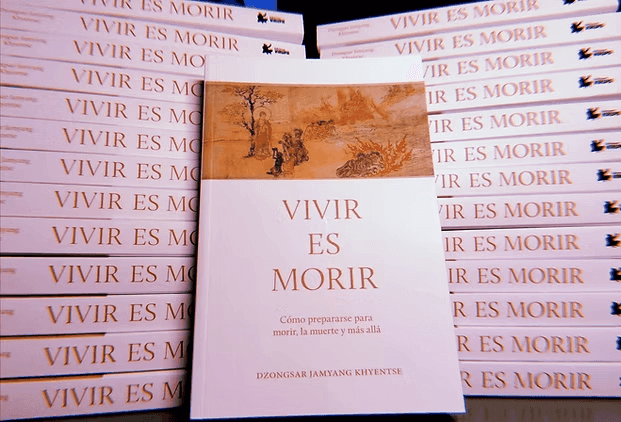
However, Dzongsar Khyentse Rinpoche clearly distinguishes the realm of humans, as is traditionally done, which Trungpa Rinpoche does not. I believe the kagyupa presents the realms of existence from this perspective to emphasise that all the realms are passed through by humans, whereas Khyentse Rinpoche uses his description to speak specifically of the human world, since it is the optimal one for spiritual practice: neither so blinded by pleasures nor so clouded by suffering as to fail to commit to the Dharma.
That said, both perspectives diverge from the traditional one; some of us already know it from The Triple Vision, though it can also be found in the Tibetan Book of the Dead. From a more orthodox standpoint, these worlds are described not in psychological terms but ontologically: they are planes that coexist alongside our own. The descriptions of each of the realms are very detailed, and for the sceptical Westerner they border on fantasy: for example, the pretas are described as a kind of hungry being with a tiny neck and an enormous stomach, through which everything consumed is lost. In hell, whether cold or hot, different kinds of suffering and atrocious pains are detailed, with specific names even: such as the Icy hell of "brrrr".
Of course, for Buddhists the ontological, that is, what is, the world of being, and the psychological, in essence, present no distance between them. I recall that once S.S. Gongma Trichen, teaching on the hells, observed that many people listen incredulously to these accounts, as if they were a mere exercise of the imagination; yet these same people fall prey to their own dreams and to their waking state, believing that everything that happens is equally real and solid. I think it makes sense to point out that the best thing that could happen to us would be to believe the traditional account wholeheartedly, since what most of us lack is precisely the capacity to take seriously the urgency of practice. There is something of the medieval fear of the fury and punishment of God that is indispensable in times of spiritual scepticism.
Thus, if one attends to an orthodox explanation of the realms of existence and doubts one's own judgement sufficiently — that is, one has exposed oneself to the fallibility of one's projections and has understood, even minimally, the mind's tendency to reify — one can use it to develop renunciation. Indeed, this is the purpose of this kind of teaching, whether Trungpa-style or orthodox: that we come to abhor, even to the point of horror, the mental states we pass through which, without any training or mental discipline, can become experiences as vivid as the earth we believe we are standing on right now.
*******
This short article is by a student of the Buddhist Studies Group of Casa Virupa. It forms part of a presentation that Lama Norbu assigned to students on some topic from the work The Myth of Freedom.