The Path of the Great Yogini: Life and Realisations of Yeshe Tsogyal
- 25 Jan 2026
- 15 min read
Today, on the occasion of the 25th day of the lunar calendar, Day of the Dakinis, we present the first half of an article on the life of the great Tibetan yogini, Yeshe Tsogyal (8th c. CE). For hundreds of generations Buddhist practitioners have remembered Yeshe Tsogyal in songs and prayers, for her life was an example of devotion to the spiritual path and of fearless, tenacious determination.
The story of Yeshe Tsogyal that I discuss here, the most famous one, belongs to the namtar literature, or "stories of liberation", a genre specific to Tibetan Buddhism that consists of a spiritual biography or hagiography. These stories tell of the lives of Tibetan or Indian yogis and yoginis or mahasiddhas who attained complete awakening. What is remarkable about this kind of biography is not that it reproduces the facts faithfully, nor even that it portrays the protagonist's personality truthfully, but that, above all, it serves as an inspiring text for the practitioner who reads or hears it, and even as a complement to the tantric instructions.
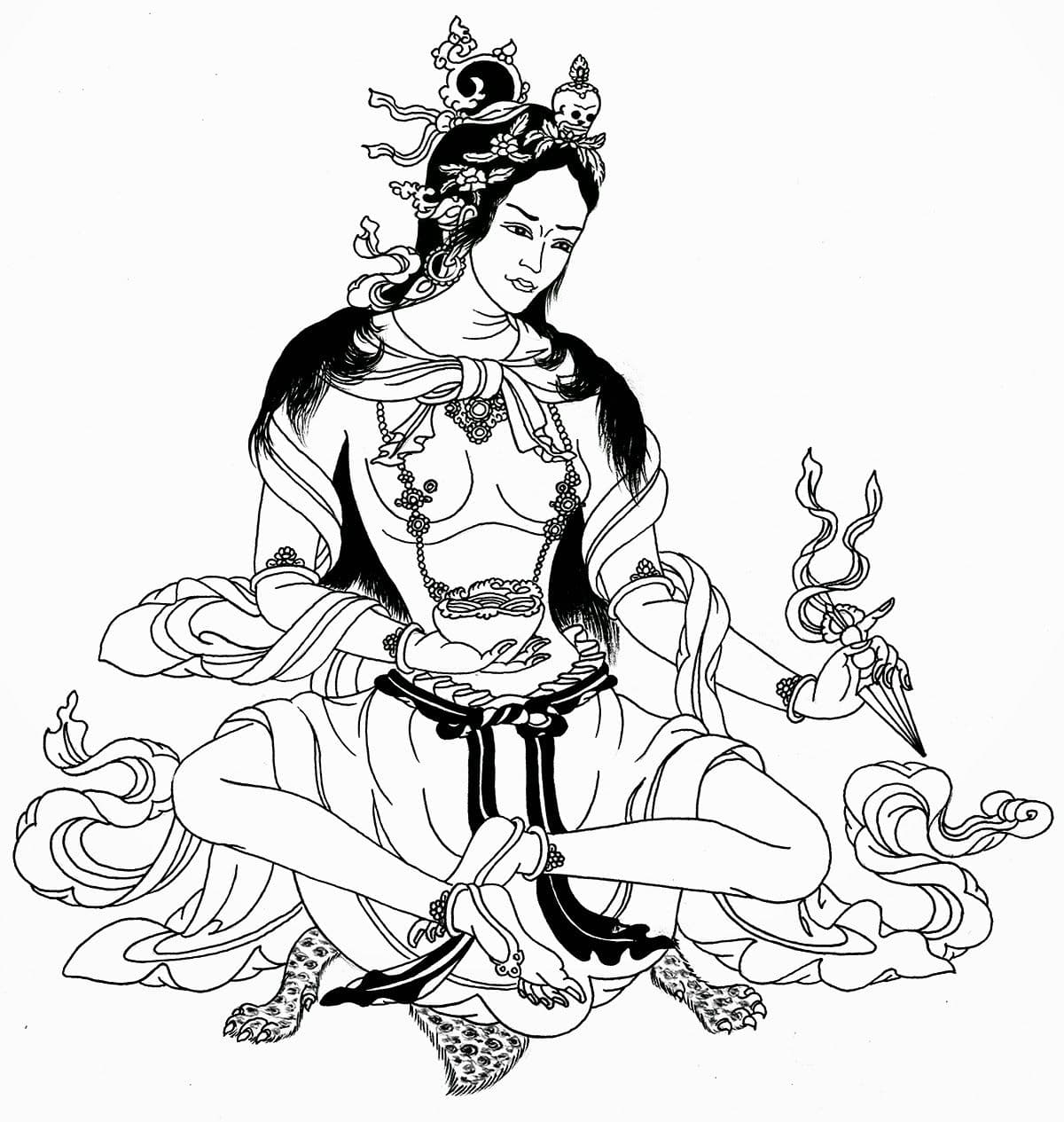
The work consists of a series of recollections told by Yeshe Tsogyal herself, along with direct testimonies from some of her closest disciples. The text was compiled and hidden as a terma (*) to be revealed almost a thousand years later, in the 17th century CE. It was Taksham Nuden Dorje, the yogi and treasure revealer, who deciphered the symbolic script of the dakinis in which the text is written and composed it in Tibetan, attributing the authorship to Gyelwa Jangchub and Namkhai Nyingpo (8th c. CE), two notable disciples of Padmasambhava and Yeshe Tsogyal.
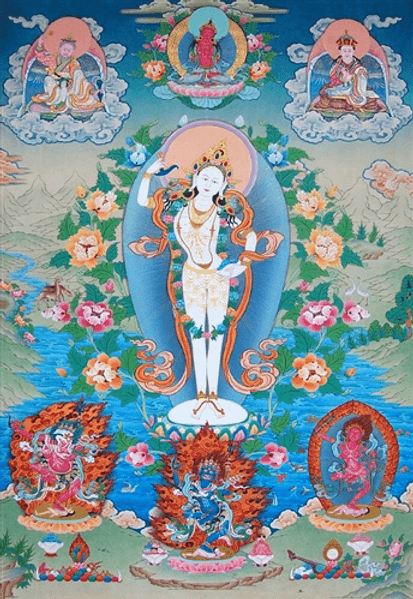
The reader familiar with Buddhist texts will see, at the beginning, a structure similar to that of other works: it opens with a homage to the sublime beings. Given the most intimate bond of the protagonist with Guru Rinpoche, he, of course, as well as Buddha Amitabha and Avalokiteshvara, are cited in this homage. The lamas of the lineage are also honoured, as is Yeshe Tsogyal, the mother of the Buddhas of past, present and future, and her three emanation bodies. Next comes a beautiful praise of the great Yeshe Tsogyal, "she who delights the Buddhas, to whom the great Orgyen entrusted his divine authority, she of infallible memory, the matrix of the profound hidden treasures, she who attained supreme power, the rainbow body, a vajra body". Thus begins the story of Yeshe Tsogyal, Victorious Ocean.
In the first chapter, concerning the conception, it is explained that, in one of her previous rebirths, Tsogyal, as the daughter of a merchant, appeared before the Buddha and expressed her vow to be reborn solely for the benefit of beings. In another existence she became the Hindu goddess Ganga, venerated Buddha Shakyamuni and became the goddess Sarasvati. Then, according to the text, seeing the need to spread the Buddhist teachings in Tibet, Padmasambhava reflects: "now is the time for the goddess Sarasvati to manifest and help me spread the teachings of the mantrayana", which leads to the conception of the human Tsogyal and to her birth. It is said that Padmasambhava had as many consorts as sesame seeds that fit within the four walls of a house; yet of all of them, six stood out, as emanations of the body, speech, mind, activity, quality and essence of Vajravarahi, a more esoteric aspect of Vajrayogini. Of these six, two consorts were the foremost, Mandarava and Yeshe Tsogyal, the latter being the emanation of the speech of Vajravarahi.
Thus the conception of Tsogyal is narrated on two levels. On the one hand, in her supramundane form, Guru Rinpoche and Yeshe Tsogyal meet in the supramundane realms in order to beget Tsogyal. On the other hand, and now entering the second chapter, Yeshe Tsogyal says: "One day, when my father, lord of Khartchen, was 25 years old and was with my mother, the queen, enjoying the pleasures of love, my mother had a vision". Her mother sees a golden bee coming from the west, singing the most enchanting melody that no lute could ever have played, dissolve into the crown of her husband's head. He sees his wife with three eyes and a little girl of eight years old with a lute singing: "a ah i ih ou ouh ri rih li lih eh eeh o oh am ah" and "hri hri hri hri hri". The girl approaches him and disappears. Then the earth trembles, there is a burst of light, a loud thunderclap, followed by a long, faint roar. It is said that a small spring near the castle turned into a lake and other extraordinary things occurred.
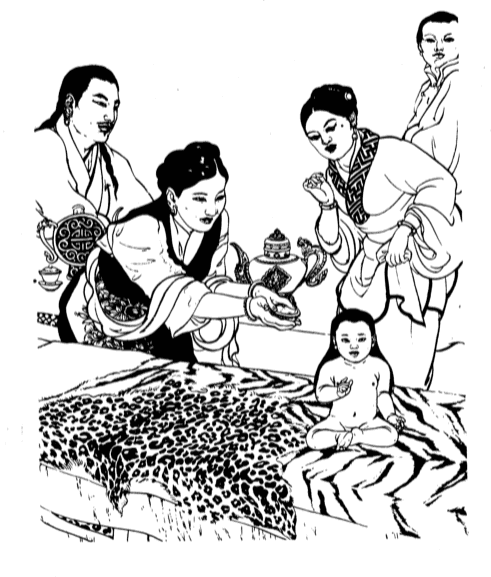
Other extraordinary visions appeared to the two lovers throughout the night and, nine months later, the queen gives birth painlessly to a girl with extraordinary abilities. Shortly after being born, for example, the little girl chants syllables and consonants. And she says, kneeling or seated with her legs crossed, with her enormous eyes open: "Homage to the great sage of Orgyen!". Her father thinks that she will either be a great teacher or the consort of an emperor, in an obvious parallel with the life of the Buddha, and, since a lake had overflowed when she was born, he decides to name her Yeshe Tsogyal, Victorious Ocean.
Despite this extraordinary birth and conception, her parents place no value at all on their daughter's signs and abilities and are concerned only with arranging a good marriage for her. Tsogyal's worldly beauty arouses much jealousy among the kings competing for her, and she, for her part, does not wish to marry any of them, as she does not want a conventional life. Faced with the difficulties of a daughter so reluctant to marry and two suitors with no intention of giving way, the parents decide that whichever suitor first catches their daughter will marry her. After a savage pursuit, they finally capture Tsogyal, but she resists to such a degree that “her feet sank into a rock as if it were mud” and, only after being whipped until her back was utterly bloodied, does she yield. Even so, Tsogyal's determination to attain enlightenment in this lifetime remains unshaken, and she says to her captor:
If this body, finally obtained after thousands of years,
Does not serve me as a means to attain the state of Buddha,
How could I use it as an instrument of torture in this cycle of existences?
Kartchou, prestigious man who makes authority the law,
You cannot offer me, not even for a single day, the favourable conditions for the realisation of awakening.
So then, kill me, I don't care!
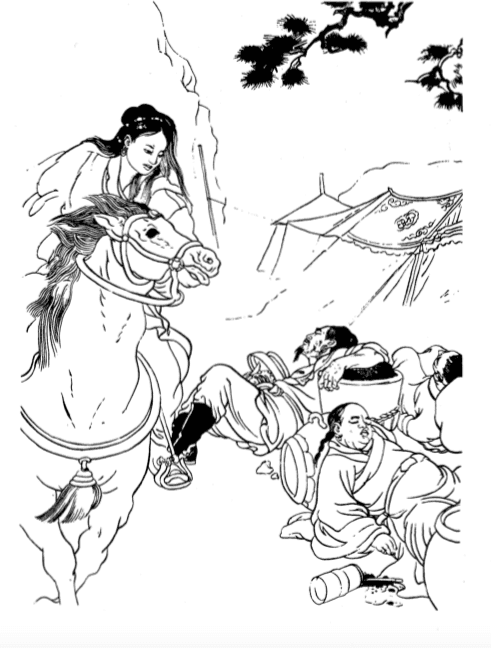
In another parallel with the life of the Buddha, while her captors lie fast asleep after the celebration of Tsogyal's capture, the princess manages to escape. She lives in a cave, feeding on berries, until she is discovered and, once again, the suitors threaten to start a war. This time, however, Emperor Trisong Detsen intervenes and decides to take her as his consort queen. Seeing her great interest in the Dharma, they appoint Tsogyal minister of religious affairs, but something better is yet to come: as the king has a great appetite for the Dharma and wishes to please Padmasambhava so that he will grant him teachings, he offers Yeshe Tsogyal as a mandala offering.
We now enter the third chapter, in which events have taken a turn that is perfect for Tsogyal, since she cares only about learning the teachings and her guru wishes to teach her. Once they are alone, the master teaches her the Buddha's Four Noble Truths, as well as the provisional truths of the Tripitaka, the inexorable law of karma, and what she must cultivate and everything she must renounce. Everything the master teaches her, she understands and integrates; her meditation becomes stable, her understanding of the teachings clear and her knowledge perfect.
In the fourth chapter it is recounted that the young yogini—for she is only sixteen years old when she goes off with her master—begins to acquire powers and divine insight and, after serving the Guru with the three kinds of satisfaction for a long time, her mind is fully aligned with the path of virtue. However, she has not yet received the higher teachings, which she begs of her guru. He, pleased, entrusts her with keeping the tantric samayas (commitments, vows), to which she agrees, happily. At this point in the biography, for let us not forget that this is also a teaching, Tsogyal offers a thorough explanation of the samayas that must be kept as a tantrika.
After that, Tsogyal explains that, in the kingdom, rumours begin to spread that she has disappeared, and the emperor, Trisong Detsen, unable to keep the secret, finally explains that he had offered Yeshe Tsogyal as his consort. The ministers, many of whom are Bön, are outraged and want Guru Rinpoche and his consort to be expelled. Eventually an agreement is reached: Guru Rinpoche must return to India and Tsogyal must be punished through exile. The spiritual couple make it appear that they will do so, but in reality they escape to some caves, where they continue to practise.
There Guru Rinpoche bestows tantric empowerments upon her, and Tsogyal describes in meticulous detail the various mandalas of the deities and so on. Yeshe Tsogyal also describes the different realisations she gains through practice, either alone or with the guru. And before granting her the fourth empowerment, the highest teachings, Padmasambhava says to her:
Lady, without a valiant companion as skilful means, you will truly have no way to undertake the practice of the secret mantra. When a clay vessel has not been fired, it cannot hold anything; when there is no firewood, it is not possible to make a fire; when it does not rain, shoots do not sprout. And so, in the land of Nepal, if by chance he has found the way from Serling, in India, there lives a young man who answers to the name of Atsara Salé.
Thus, Tsogyal sets out alone on a journey to Nepal and, along the way, seven robbers steal all the gold she is carrying. However, owing to her high realisations and her strong conviction in the Dharma, she converts the wrongdoers and teaches them to transmute their low, aggressive energies into an awakened, Dharmic expression. Finally she arrives in Nepal and finds Atsara Salé, who serves as a slave to a family. To his owners she says:
Where the perfect Buddha dwelt,
There was no need for skilful means.
Now the Buddha has gone, so I must rely on such means.
Tomorrow, means and wisdom will be united.
When the fruit has truly been gained,
There will be no need for Salé.
But, while I walk towards that goal,
I need him.
Therefore, sell him.
As she does not have enough money, she has to perform a miracle to obtain it: she revives the son of a noble family who, moved, give her all the gold needed to buy Salé. On the way back, Atsara Salé and she go to visit Sakya Dema, who at that time was probably more accomplished than Tsogyal. Sakya Dema is another of Guru Rinpoche's most important disciples, one of his six principal consorts, the emanation of the mind of Vajravarahi. Tsogyal asks Sakya Dema for teachings, and Sakya Dema asks Tsogyal for teachings. The two also recognise each other as consorts of the same guru and, at the end of the encounter, Tsogyal says: “then our minds joined in the mind of the Buddha and we exchanged precepts and instructions”.
Back in Tibet, they set out in search of Guru Rinpoche, who gives her and her consort instructions for their practice, and Yeshe Tsogyal and Atsara Salé spend months practising together, both attaining high realisations and serving as spiritual support for each other's practice. Afterwards, the teachings that Guru Rinpoche gives to a retinue of disciples, among them the master's 25 most notable, are explained, and he entrusts Yeshe Tsogyal with entering retreat (in a cave in Tidro and in other places). The master reminds her that, in the face of any adversity during practice, she should pray to him, because he will attend wherever she is.
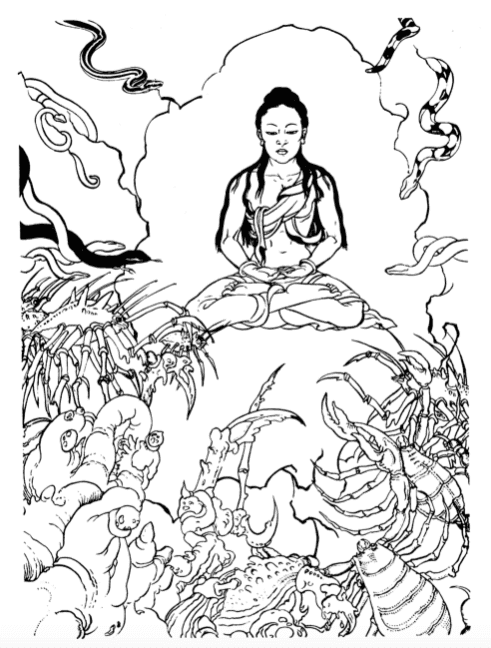
Thus begins the fifth chapter, in which Tsogyal recounts how, once retired in the caves, she soon enters deep states of meditative absorption and is inseparable from the yidam. She also recounts her experience of a vision of Oryen Khandro Ling, the Land of the Dakinis. She gives a meticulous description of this pure land, full of mountains of skeletons and fragments of bone everywhere. The celestial palace is made of skulls, dried heads and human skin. There are cemeteries, lightning, vajras everywhere. Flesh-eating animals, demons and similar creatures.
Many dakinis bring offerings of all kinds to the principal Dakini: her flesh, the blood from her veins, her eyes, her nose or tongue or ears, her hearts and lungs, all her fluids, and so on. When Yeshe Tsogyal, surprised, asks them why they pursue pain in this way, they respond:
If you fail to offer consciousness at the moment it is born,
Procrastinating, the merit is lost.
Delaying, obstacles and impediments multiply.
Insofar as we have obtained this body for a moment,
There is only one moment to celebrate the path;
If you do not offer this auspicious body while you have it,
Delaying, obstacles and impediments multiply.
Just as the Master appears only for an instant,
There is only one instant to enter the gate of the mysteries,
If you do not make offerings to the teaching at the moment you possess it,
Delaying, obstacles and impediments multiply.
On one of the visits his master makes to her, she explains the vision she has had, and he tells her that it was a symbolic vision and that it is not yet necessary for her to make the offering of flesh. In fact, it will be better for her to practise the eight austerities: the austerity of food; of clothing; of speech; of the body; of the mind; of the teachings; of compassion; and the austerity of benevolence.
These are extremely harsh ascetic trials that bring Tsogyal to the brink of death on numerous occasions; on all of them, however, her devotional pleas to the guru cause him to come, in the form of apparitions or visions, and she manages to recompose herself and overcome the practice, mastering each of the yogic austerities. Particularly moving is the way she herself encourages herself and invokes her guru when she feels on the brink of death:
(…) now the essence of every profound human situation
the direct path of the tantric teachings
is quickly traversed with austerities
therefore, resist whatever happens
there is nothing more to do
death is not an alternative.
Courage, Tsogyelma!
KHYEMAHO!
After this period of austerities, not all of them yet completed, the Guru urges her to strengthen herself through the use of essential elixirs and plants, and warns her that, once he has hidden termas for the benefit of beings in the future, he will depart for the Land of the Dakinis, as his time to die is near. Yeshe Tsogyal, Salé and a girl go to Bhutan, where Tsogyal retires to continue practising the austerities and attains high accomplishments, such that she is already considered a siddha.
Part of this article is work produced by a student of the Deepening in Buddhism Group.
***********
NOTES
(*) The text on which I have based myself to speak about Yeshe Tsogyal is a terma, that is to say: a treasure-text. Therefore, to speak of the biography of Yeshe Tsogyal is to speak of Dharma, so the author is a poor and unqualified mouthpiece. Likewise, I will try to explain it in case it is of interest and benefit to someone, but I strongly encourage the audience to receive the text and its explanation from a qualified teacher.
***********
The quoted passages from the biography are, for the most part, translations made by myself, either based on the translation by Keith Dowman or on that of Padmakara. In some cases I have also used the translations of Simmer-Brown 2007.
Most of the illustrations are from the work of Keith Dowman, cited below.
So as not to distract the reader with bibliographical references, I have omitted them from the text. But anyone who is interested in knowing the specific references for the quotations may contact us so that we can provide the article with the clear references. Likewise, I set out below the texts used in writing the article:
Bibliography:
- Dowman, Keith (1984) Sky Dancer: The Secret Life and Songs of the Lady Yeshe Tsogyel. Snow Lion Publications: London.
- Gardner, Alexander (2018). “Yeshe Tsogyel”. Treasury of Lives website. Available online: https://treasuryoflives.org/biographies/view/Yeshe-Tsogyel/TBRC_P7695
- Gross, Rita M (1987) "Yeshe Tsogyal: Enlightened Consort, Great Teacher, Female Role Model." The Tibet Journal 12, no. 4: 1–18.
- Khyentse, Dzongsar Jamyang (2016). The Guru drinks bourbon? Shambala Editions: India.
- Lion’s Roar ed. (2016). “What are the three kayas?”. Lion’s Roar online magazine. Available online: https://www.lionsroar.com/buddhism-by-the-numbers-the-three-kayas/
- Mora, Fernando (2006). The Teachings of Padmasambhava and Tibetan Buddhism. Kairós: Barcelona.
- Simmer-Brown, Judith (2007). The Warm Breath of the Dakini. MTM Editores: Barcelona.
- Simmer-Brown, Judith (n.d.). “Yeshe Tsogyal: Mother of the Victorious Ones”. Extract from the book The Life and Visions of Yeshe Tsogyal. Shambhala Publications. Available online: https://www.shambhala.com/yeshe-tsogyal-mother-of-the-victorious-ones/
- Tchangtchoub, Gyalwa y Nyingpo, Namkhai (2005). The Life of Yéshé Tsogyal. Sovereign of Tibet. Éditions Padmakara: Peyzac-le-Moustier.
- Willis, J.D. (2009) “On the Nature of rNam-thar: Early dGe-lugs-pa Siddha Biographies” in: Aziz, B.A. & Kapstein, M. (eds.) Soundings in Tibetan Civilization (Kathmandu): 304-319.